Sure, Woodstock had almost half a million attendees. For a tech conference, WADWC is massive though: It gathers 15-thousand developers in Berlin’s expo halls for two days, and even navigating the space becomes slightly overwhelming. Less mud I guess.
WADWC’s setup is otherwise fairly vanilla: Presentations at a dozen-plus concurrent stages, and sponsor booths in-between. It feels almost more like a fair or trade show, and hence a bit impersonal at times. Albeit the pure amount of content guarantees a broad selection of topics. Since recordings are only available for attendees, here’s at least the aftermovie:
Official aftermovie for WeAreDevelopers World Congress 2025 in Berlin
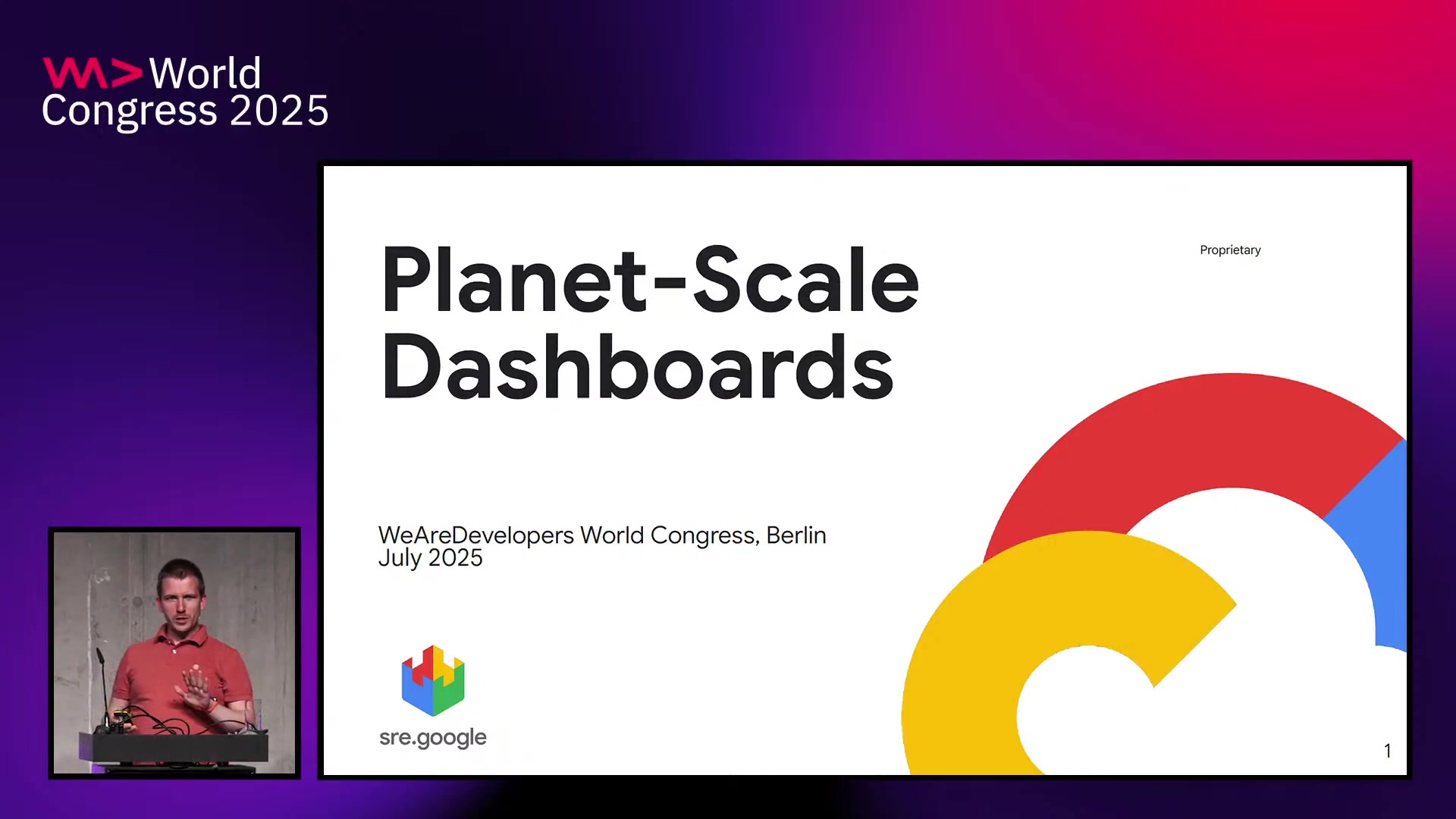
Now, in my defense, this was the third venue I presented Planet-scale dashboards at (thanks to Chris for moderating my stage!), and it all became a bit hazy at that point. I’ll briefly highlight my two favorites:
In God we trust, all others must bring data
Jeff Watkins (of Compromising Positions podcast fame) talked about Taming the Wild West of Information Overload and he did so by first distinguishing between a number of different types of wrong information:
- Misinformation
- unintentional mistruths, confidently wrong
- Disinformation
- deceit, propaganda
- Malinformation
- largely true, but missing critical context; “real information gone bad”
- Noninformation
- information with no intent at all; drowns out real content by just seeking engagement
- People’s truth
- what we want to be true; illusionary truth
Equipped with those categories, Jeff defined an infodemic as a situation where —much like a biological pandemic— the of spread is high. The first interesting parallel is that the malaise (lies) travels faster than the cure (facts): “juicy stuff” gets reshared quickly and frequently, whereas corrections or retractions get little attention. Secondly, even non-symptomatic patients (those who don’t actually believe the information) can contribute to spread (retweets and such.)
Jeff closed on a fairly dim note — the information apocalypse: the collapse of truth, “really dark territory.” He conceded he had no idea how to come back from that but pointed at individual protections like Media Bias/Fact Check, literacy courses (archived PDF version), and the following books:
 Foolproof
Why We Fall for Misinformation and How To Build Immunity
(2023)
Foolproof
Why We Fall for Misinformation and How To Build Immunity
(2023)
 FAIK
A Practical Guide to Living in a World of Deepfakes, Disinformation, and AI-Generated Deceptions
(2024)
FAIK
A Practical Guide to Living in a World of Deepfakes, Disinformation, and AI-Generated Deceptions
(2024)
 The Psychology of Misinformation
(2024)
The Psychology of Misinformation
(2024)
There are recordings from prior events (where, after skipping through it, I’d say his presentation wasn’t as refined yet.)
Videogames: The Medium of the 21st Century
Warren Spector took the stage, and if you don’t know who that is, first off: congrats on your youth. His Game Developers Choice Lifetime Achievement award is well-deserved after producing the Ultima series (Origin), Deus Ex (Ion Storm), and Epic Mickey (Junction Point / Disney).
Warren pointed out games are a unique medium of the 21st century:
- Power to transport
- it’s you doing something, not an actor
- Immersiveness
- you’ll believe you’re in another world
- Participation
- doesn’t just allow participation, it requires it; you have to help
- Responsiveness
- two way medium; the medium changes
Warren also shared an interesting observation about DnD: The dungeon master owns the shape of the story, but the content is produced by the player group.
Who played the other stages
There were a number of interesting sound bites from other talks as well:
-
Hendrik Lösch pointed the blame for why (most) software projects fail silently at our fizzling attention span: Project have high velocity at the beginning, which sets (unrealistic) future expectations with stakeholders.
-
Anu Bharadwaj shared one of those tips that seem obvious in hindsight, but are often ignored: Measuring developer joy ("DevEx") is non-trivial. Instead of coming up with ever-more complex proxy measures, just try asking —surveying!— developers for their satisfaction.
Everybody loves progress but nobody likes change
-
Paul Adams shared the journey he’s taken Intercom on as their Chief Product Officer: They ripped up the classic engineering, product, design triad because it turned out too slow for them. Instead, they invented new roles like the now-popular forward deployed engineers or “demo designers.” Paul likened the moment we’re in with AI to what TikTok would’ve felt like in 1999.
-
Alejandro Saucedo grumbled that a lot of AI tooling is focused on the “top of the funnel,” not the bottom (let alone the entire chain): In software development, it really helps with code generation, but not so much with review, QA, operations, testing, and monitoring yet. In music, it helps with sound production, but not with mixing.
-
I have to hand it to Thomas Dohmke: Doing another live demo on the main stage after his last one ran into technical difficulties three years ago — only to have it fail again — is a ballsy move. Thomas surmised AI would likely write 90% of code at some point and, crucially, not replace human developers.