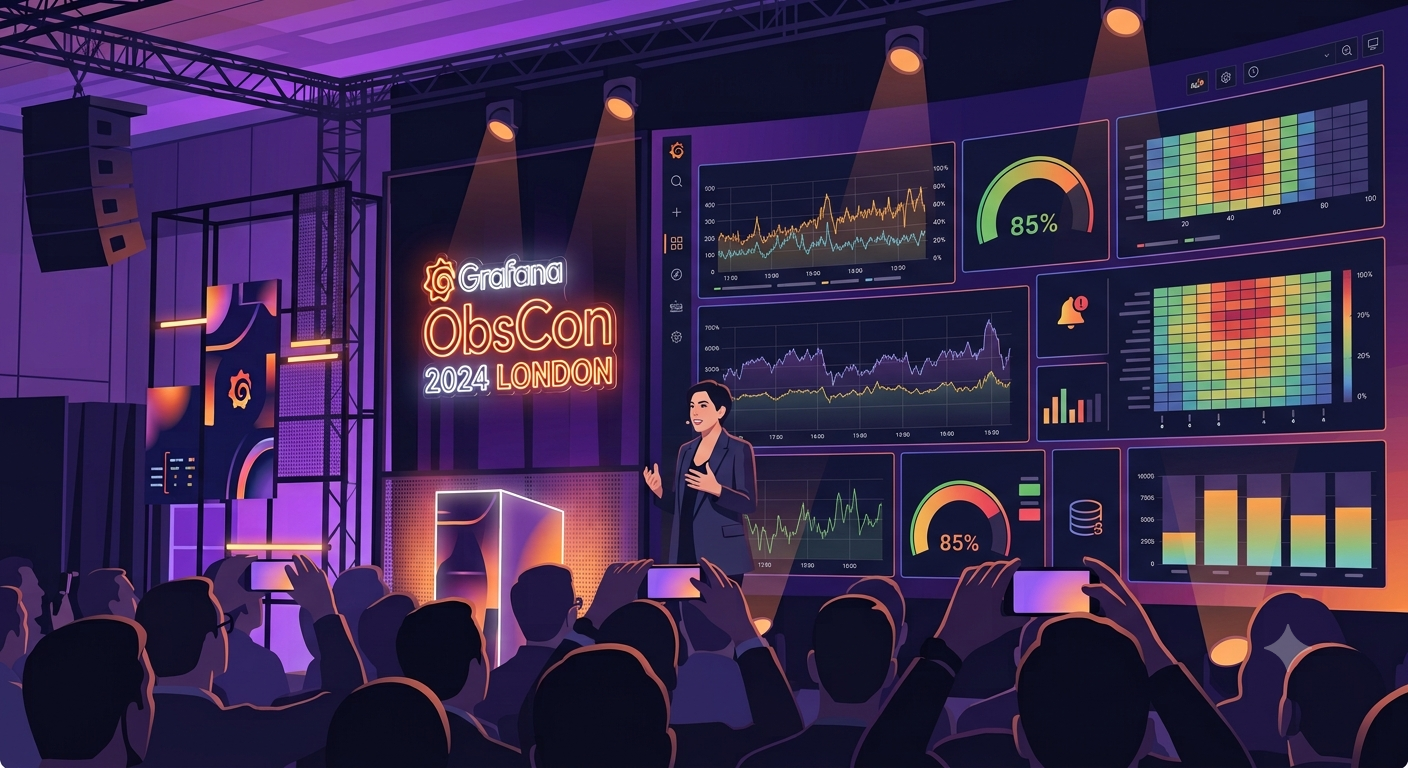
I’ve been out of the conference circuit for some time now, so it was fun to rediscover how each pocket of the industry has its own little quirks and rituals. For example, in Observability everybody seems to pronounce the namesake numeronym (‘o11y’) as OLLY, which felt super odd at first (who’s that Oliver guy?).
One thing that each industry with a consulting arm has in common, though, is how
nothing’s ever complete: Every company —
Dexory
in this particular instance — went out of its way to note how they’re ‘still
early in their o11y journey.’
Nobody ever seems to be done with o11y
.
If you only watch a single talk, let CTO Tom Wilkie give you a whirlwind tour of, well, everything:
Tom takes his sweet time until minute 9, but he’s in good company
Highlights were:
- The Explore apps are really neat and allow to quickly (manually) perform Key Driver Analysis.
- I think k6 scripted checks are really cool, since they reduce code between (load and performance) tests and probes (synthetic monitoring).
- Tom was most excited about the use of generative AI in
Incident Rooms
— understandable, just weeks after the release of ChatGPT
o1-preview.
It’s a small, small world
The industry seems to gravitate towards a model of Federated Observability right now. It’s a sound concept: Give teams agency and they will handle their use cases themselves. That applies to both, the common and the one-in-a-million. There is little-to-no concept of extensibility, of platforms or shared/common infrastructure. You build your own kingdom.
That right there is also the primary weakness of this approach:
“We [Explore Traces] built an app as well.
New features are built out quickly, which is great. However, they are also commonly bespoke and point-to-point; in a way that works well for 80% of use cases, isn’t integrated with anything else, and fairly often only works in Grafana Cloud.
That works well up to a point, but has serious gaps in large enterprise deployments.
The buck stops… where?
I was fortunate enough to have some conversations with Grafana Labs staff throughout, and learned a couple interesting things:
- User experience (UX) roles — or “product designers,” as they call them — are always embedded into engineering teams. They spend non-trivial amounts of time there to really ramp up on the subject matter.
- UX cannot block a launch. This is ‘working as intended’ for them: If UX wants for change to happen, they need to accelerate development, not block it.
- The Customer Advisory Board (CAB) is a forum of customers doing a mix of guided UX panel and monitoring working group. Currently, it consists of ~70% companies in the financial sector.
Update: Added 2025 CAB post.