LDX3 used to be three distinct conferences: LeadDev, StaffPlus, and LeadingEng. They were consolidated last year —just in time for LeadDev’s tenth anniversary— into one 2,500-people strong conference.
This merger makes the event cover a fairly tall stack of topics across seniorities. More visibly yet, it features a number of different formats:
- Obviously, it had the classic talks and workshops.
- There were demos, meet the author sessions, speed coachings, Ask Me Anything panels, and stage discussions (“The Big Debate”).
- The communities could mingle in community groups (either by representation or industry), solution swaps, roundtables and “table talks,” one of which I was proud to host.)
- Even more casual forums like huddles and peer hangouts had their place on the agenda.
The data is in…
A few companies presented their newest research around industry trends.
Justin Reock presented DX’s AI Impact Report. Compared to the Q4'25 report, there were a number of surprising finds:
- 93% of surveyed companies now reported adopting AI, and the number is likely much higher taking Shadow AI into account.
- Rust saw the largest time savings (an hour, or 20%, more than the runner-up, Go.)
- Impact has an enormous variance —from strongly positive, over neutral, to strongly negative— across companies by all measures (code maintainability, change confidence, and change failure rate.)
- Traditional (non-tech) enterprises now see a more marked AI uptake.
Scott Carey (LeadDev Editor in Chief) presented the Engineering Leadership Report with the key insight being that “management is being squeezed:”
- As scope of leaders — engineers at staff level and beyond, as well as all levels of managers — increases, so do the working hours.
- Most remarkably, the “player-manager” is making a comeback: Managers are finding themselves doing hands-on, technical work again.
- And perhaps unsurprisingly, many managers are considering transitioning back to an individual contributor role. Charity Majors' pendulum is swinging hard.
As long as the 2026 report hasn’t been published yet, check out the 2025 version.
(A)I am inevitable
Randy Shoup (of eBay fame), Lawrence Jones (incident.io), Maude Lemaire (Cursor), and Birgitta Böckeler (Thoughtworks) held a panel about the “drudgery of AI-generated code.”
An audience member posed an interesting scenario: Junior engineers increasingly stop to actually learn, now that AI tools can provide a convenient shortcut for many tasks. Should we hence cut their access to AI? The panel didn’t think that was the right solution, however; Randy likened it to trying to teach a young chef how to cook properly without handing them any knives.
Funnily enough, Rick Clegg (Wise) saw the positive side of that in a later session: Junior engineers are often much less reluctant to adopt AI because they may not be otherwise used to being in the zone, to the “tippy-tappy” of yore.
The panel was worried we —as an industry— would atrophy, but delegated that challenge to trained educators and psychologists. They forecasted engineering knowledge would largely shift from syntax to architecture.
They veered awfully close to taking a critical stance — at times uttering phrases like “capitalism is the root of all problems” and that we should “build for humans, not shareholder value” — but then lost itself in a collective shrug, with Lawrence concluding:
This may be the last chance to build a software company. Who knows if SWEs will still be needed in five years, but at least we’re at the forefront.
To review, or not to review
While the AI panel generally embraced the direction of vibe coding, they were struggling with the increased throughput of code reviews. They recognized the looming quality and reliability problems.
Maude also remarked that reviews don’t just (try and) validate correctness, but have a number of other, tangible benefits:
- Learning, both on the reviewer and the reviewee side
- Knowledge sharing for that dreaded 2am incident debugging
- And, at least for the time being, compliance
She was optimistic modern approaches like screenshot-based testing could help stem the tide.
Iceberg ahead!
Back to a bird’s eye view, Maryia Tarpachova beautifully illustrated systems thinking, the idea that similar structures produce similar behavior. It was originally spearheaded by Dana Meadows in her seminal work Thinking in Systems.
A theme park can grow by adding more rides — up to a point. Eventually, as the roads to the park will become congested, that simple equation won’t work anymore:
The way to scale is not to push harder, but to redesign the system around constraints.
The flip side of this is that no matter your excellent hiring or sparkly tools — if your overall workflows suck: you will fail sooner or later.
Right around the corner hosting a bunch of other sessions, Stephen E. Morris had a fair critique of systems thinking’s central iceberg model.
Nothing new under the sun
Dr. Nicole Forsgren (of DORA fame) went into why just throwing AI at a problem won’t help much if the system (e.g. approval processes) doesn’t evolve with it. That’s not an insight that’s particularly novel or specific to AI, but it seems we sometimes forget about the basics with that new, shiny toy.
Rick —maybe unintentionally— illustrated the point: One major way how Wise improved their review pipeline was through —drumroll— a Slack bot for pull request notifications.
Another interesting observation in the AI panel was that linters are in a bit of a (positive) squeeze: Why would we continue writing or configuring linters, when we can just stuff another half-sentence into the system prompt?
Translating up
Rob Zuber (serial CTO, now at CircleCI) ran an excellent workshop on C-level engineering advocacy. An interesting observation he made:
- If you ask an engineer to sell a product, they will come back with the customer’s exact problem statement. They will know their tech stack and their entire product suite.
- If you ask a salesperson though, they will tell you about the customer’s org chart. While knowing next to nothing about the domain, they will know exactly the person with purchasing power, and/or the person to talk to next.
Rob made a bunch of good points about those squishy aspects of leadership:
The worst time to get to know your CFO is when asking for $10M.
He mentioned Marquet’s Ladder of Leadership (formerly the Ladder of Control, or Intent-Based Leadership). It’s an oft-rehashed idea that you can collaborate along a spectrum — if you search for levels of delegation, you will find a myriad of models ranging from 3–7 levels.
Don’t set yourself on fire to keep others warm
Ian Coldwater then built an interesting bridge between engineering leadership and community activism. They pointed to the grassroots movement of “geeks” manufacturing whistles as part of the 2026 Minnesota protests in order to illustrate that leaders need to:
- Put themselves between aggressors (be that immigration enforcement gone rogue, or that pesky coworker always raiding the office fridge) and the vulnerable.
- Identify those who aren’t seen, performing the silent glue work.
- Sometimes, as silly as it may seem, wage some of their social capital to ask for an acronym to be explained, just because those junior engineers won’t.
Nepa!
Last but not least, King Immanuel Edoh provided a highly authentic peek into engineering under non-ideal conditions: In his organization in Nigeria, power outages are a normal part of daily life — and so they design for them, not around them.
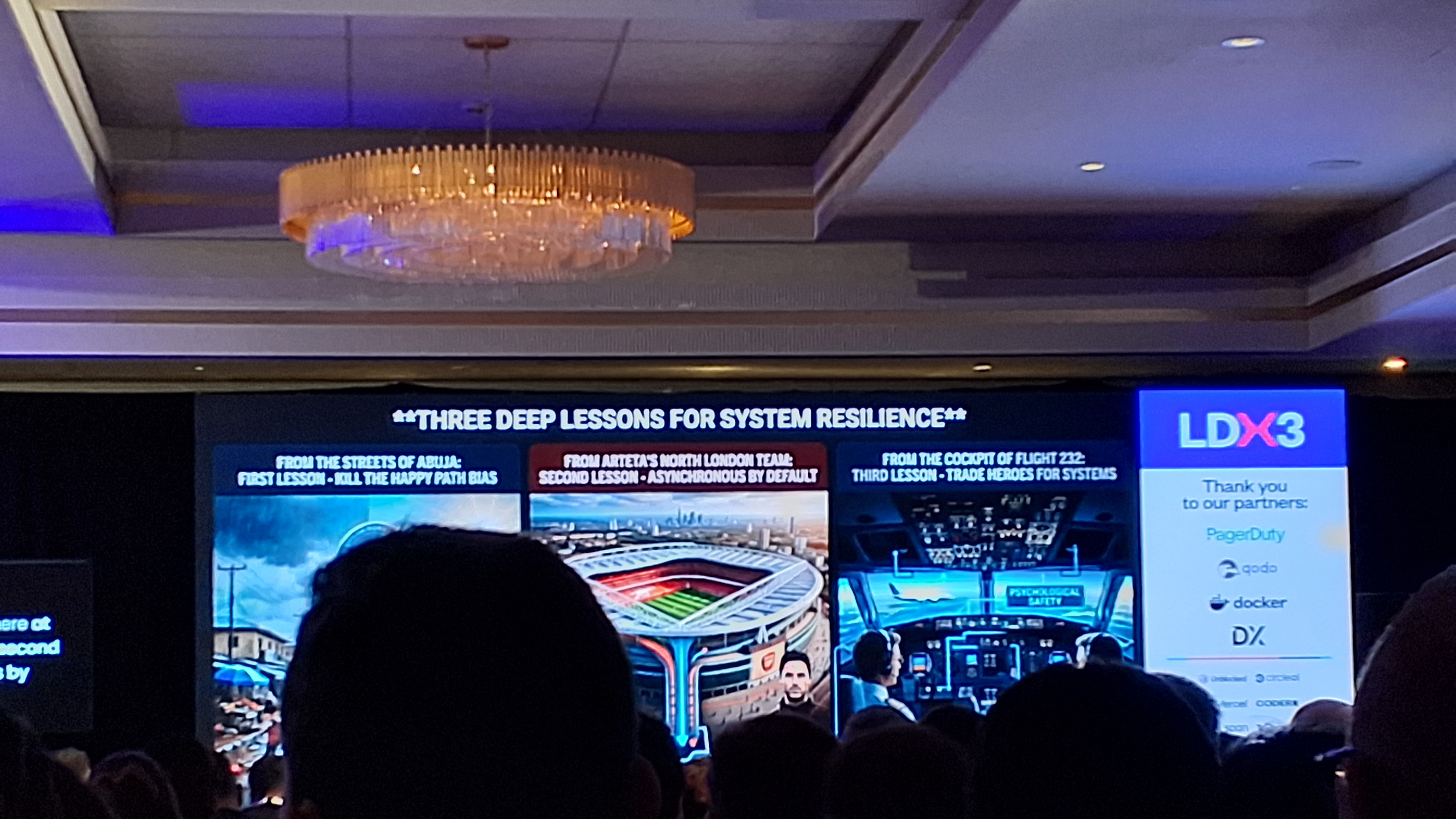
He shared why NEPA —the former name of the local power grid— is close to an exasperated expletive, and some solid advice how to cope with such an environment.
What Silicon Valley calls an advanced architectural pattern [for resilience], my engineer calls that survival arithmetic.
He also rephrased blameless postmortem culture quite aptly: Why did the system allow an exhausted human to make this choice?
And if you’re in the London Greenwich area outside the conference, too, I can highly recommend checking out The Mac & Cheese Pod (Millennium Village Square, Tue/Fri) who saved me from near-starvation and fully briefed me on the latest Southampton drama.
Update: Added video recordings.