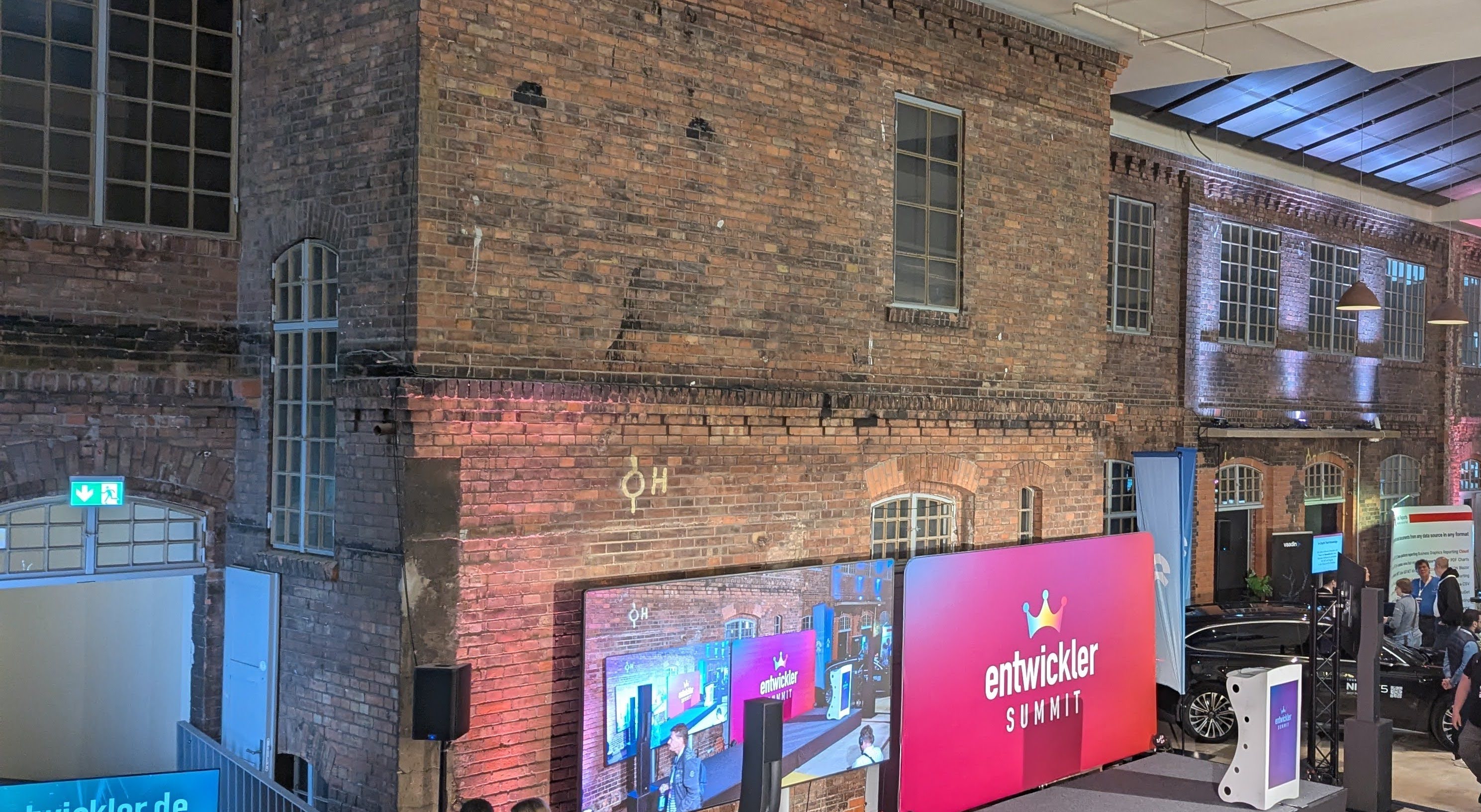
Entwickler.de by publisher S&S Media is one of Germany’s largest IT publishers. They brought their entire roster of conference highlights for its 30-year anniversary:
| JAX | Java, Architecture and Software Innovation |
| DevOpsCon | CI/CD, the Kubernetes, Platform Engineering & DevSecOps |
| iJS | Modern JavaScript Web Development |
| BASTA! | .NET, Web & AI innovation |
| IT Security Summit | Cloud, DevSecOps, Web, API, & AI-Driven Security |
| IPC | PHP & Web development |
| MLcon | Machine Learning Innovation |
| API Conference | Web APIs, API Design & Management |
The talk of the town, so to say, was AI of course. But this diverse group of speakers brought a number of other nuggets, too:
- If programming is theory building but AI can only generate code, not advance the mental model — is GenAI doomed to fail? (Dubs)
- Open source can be a policy, ideological, or economic choice, but it can also be a tool for companies to steer the industry towards a certain direction which makes their lives (knowledge, tooling, hiring) easier. (Cockcroft)
- Caution advised when replacing responsibilities with AI: That replaces competencies (Sturm) and you become beholden to the (owners of the) machines (Stephenson). But maybe the Jevons paradox forces us down this path anyways (Röwekamp).
- If we’re doomed to
reinvent the wheelrepeat our mistakes because us engineers fundamentally like solving puzzles, will AI change the picture? Instead of choosing between CORBA and gRPC in the future, maybe I’ll just tell AI to have two systems communicate and that’s it? (Frotscher) - Planetary science is pretty damn cool. (Rauer)
And some reading recommendations, along with more history books and some from Neal Stephenson:
 Powerful
Building a Culture of Freedom and Responsibility
(2018)
Powerful
Building a Culture of Freedom and Responsibility
(2018)
 Enterprise Integration Patterns
Designing, Building, and Deploying Messaging Solutions
(2003)
Enterprise Integration Patterns
Designing, Building, and Deploying Messaging Solutions
(2003)
 Human Compatible
Artificial Intelligence and the Problem of Control
(2019)
Human Compatible
Artificial Intelligence and the Problem of Control
(2019)
Scaling, Sustainability, and Simplicity
In the first keynote, Adrian Cockcroft looked back on his life as a software engineer:
- Adrian’s semi-retired now and has had a long career to look back on: Distinguished Engineer at Sun, Vice President at Amazon Web Services (AWS), founding member of eBay Research Labs, and leading the NetflixOSS platform.
- He did a Greatest Hits series in 2022 which is similar to this keynote.
- He has plenty of in-depth material on Slideshare, YouTube, and Medium/Blogspot as well as at conferences like Monitorama.
He’s talked about Chaos Engineering now and plenty in the past:
-
Famously in his series Failing Over without Falling Over (recording, alt) about Netflix.
-
The basic idea is that any service can be killed at any time, which requires services to have little–no state (such as sessions.)
-
By allowing this type of immediate scale-down, your service inherently allows rapid scale-up too.
-
A chaos monkey is a system that kills any service at random (preferably during business hours) to find services that don’t comply with this paradigm.
-
One step further, a chaos gorilla is the same but for entire clusters (or AWS availability zones.)
Adrian recalled his recent “return to serious coding” through Claude-Swarm, which instruments an entire team of AI agents to write software (and burns through a pile of cash while doing so.)
Some more tidbits strewn in:
If you ever get invited to join a venture capitalist, do it first and ask questions later.
If you want to become a Distinguished Engineer, make sure all the other Distinguished Engineers come to you when they have a question.
Leave early when your company stops growing." Especially in companies that aren’t used to resource constraints, “people start hoarding resources.”
- He suggested to think about “consciousness as an observability system: You cannot ask how you’re doing when you’re unconscious.” He’s exploring that idea in a home automation system.
- Good perspective on why giving back to open source is useful: By “pattern sharing” approaches that worked (in this case: how Netflix used AWS), we help de-bug those patterns at large.
- Succinctly described microservices as a “Run What You Wrote” tactic, where developers can change (or break) their component while leaving the rest of the system untouched.
- Netflix considers their internal culture a “competitive advantage” which is deliberately hard to copy (but there’s a book.)
- On research: “Research Labs don’t work.” It’s too difficult to move their findings from a lab-like setting into production. Instead, he advocated for operating like a lab, but continuously evaluating in production (e.g. A/B tests.)
- The most critical question for a startup is: “Who is your market and (why) do they have money to spend?”
He also plugged the Green Software Foundation, where he led better emissions reporting.
How Developer Culture Is Shaping the Future of Technology
Unfortunately, Neal Stephenson (author of metaverse-seminal book Snow Crash) only joined virtually for a fireside discussion mostly around AI. He professed he hadn’t personally used AI (but it turned out he did read quite a bit about it.) Overall, he was largely critical of AI — both of its benefits and the impact it will have.
Neal made an interesting point about education, where motivation will need to be much more intrinsic because most (high school-level) questions can probably just be answered by AI:
- His rebuttal included the following dichotomy: Do you want to know/understand things, or “do you want to be a slave to the technology?”
- Going one step further, he argued you’re not only a slave to the technology, but ultimately to the “companies owning the technology.”
- He compared this to games: Sure, we can watch an AI win a match of Go against another AI, but where is the fun in that?
His recommendation for understanding (or predicting) the future was reading history books.
Cloud Native and Kubernetes
Peter Roßbach (of Tomcat fame) discussed how Cloud Native can aid digital sovereignty. His premise was that one (e.g. the European Union) cannot attain digital sovereignty without open source/standards:
- Even third-party/foreign infrastructure such as Docker Hub inherently opens you up to outside control.
- Vendoring, of course, is one approach to protect against (potentially malicious) upstream changes.
Peter tried making points about how Kubernetes, its underlying Promise Theory, and how independent cooperating agents can make a system more resilient, but had to brush over the specifics fairly quickly.
30 Years of Interfaces
Thilo Frotscher (of Java EE 7 book fame) took an interesting look back at APIs and system integration:
- If you compare API patterns to fashion (bell-bottoms, in particular), it’s clear that hype cycles largely repeat: While the concrete implementation may be different (e.g. CORBA vs. gRPC) the problems and solutions (binary vs. human-readable encoding) are the same. That’s due to the finiteness of the solution space.
- Interfaces are fundamentally about integration, so we need to build strategy and requirements into them.
- Somewhat depressingly, we might not learn from this even when we’re aware because fundamentally, software engineers like solving puzzles (instead of looking left and right.)
From 10x to 100x Developer
Paul Dubs (of DL4J fame) discussed 100x developers using AI.
First off, he questioned how we would even define a 10x/100x developer — by lines of code? — and whether that’s a useful notion to begin with. He doubled down by defining code not as an asset, but a liability:
- Peter Naur in 1985 already argued that programming is building a theory, a shared mental model about a system. Code is a representation, but it’s not the model itself. Dead code is “when demands for modifications of the program cannot be intelligently answered.”
- By that definition, AI churns out dead code at record speeds. It cannot expand that mental model, it can only generate more (dead) code.
- Along with that come all the problems you’d encounter “when adding lots of new team members” (Brooks’ law).
As a fun side jab, Paul argued that AI-driven tab completion sometimes feels like a coworker with Tourette’s.
State of the Art 2035
Lars Röwekamp (self-professed “grandfather of software engineering”) acted out a Back to the Future play, coming back from 2035 to warn us.
His overall premise was that AI is going to replace humans, first moving us from the driver seat to the navigator role, and eventually removing us from the loop entirely:
- We will quickly move from feeding business requirements into humans who then feed technical requirements into LLMs to directly feeding business requirements into LLMs (basically, vibe coding.)
- By 2030, we wouldn’t even get to see the generated code anymore, and AI may move to a more intermediate ’language.'
- The Jevons paradox explains this: If we can easily just generate 20 solutions and pick the best, we obviously would — and ultimately couldn’t evaluate those solutions closely anymore.
- That would also lead to a moat between today’s senior engineers and tomorrow’s junior engineers: With agents sandwiched between a junior vibe coder and a senior architect, it will be incredibly difficult to progress into a senior role.
Lars had some other choice predictions:
- Since only 7% of communication (Mehrabian’s Rule) is made up of words — how we control LLMs right now — he expects to see more brain-computer interfaces.
- With the huge benefit LLMs can provide, who would be silly enough not to use them? Would that make them outcasts — and human-only intelligence be “limited intelligence?”
- And more, will that lead to a counter movement at some point? He suggested we would enjoy vintage/analog technologies again, maybe reviving LAN parties with no AI allowed.
- There will be incredibly complex security implications (see e.g. OWASP’s work.)

He mentioned many of these questions are discussed at length in books already:
 Superintelligence
Paths, Dangers, Strategies
(2014)
Superintelligence
Paths, Dangers, Strategies
(2014)
 The Singularity is Nearer
When We Merge with AI
(2024)
The Singularity is Nearer
When We Merge with AI
(2024)
 Co-Intelligence
Living and Working with AI
(2024)
Co-Intelligence
Living and Working with AI
(2024)
 Nexus
A Brief History of Information Networks from the Stone Age to AI
(2024)
Nexus
A Brief History of Information Networks from the Stone Age to AI
(2024)
 Superagency
What Could Possibly Go Right with Our AI Future
(2025)
Superagency
What Could Possibly Go Right with Our AI Future
(2025)
Lars closed with a few questions:
- “AI is only software, and it is software.” Why are we humanizing it?
- Enterprise software today has monitoring, quality control, security, and lots of other activities downstream of pure engineering — why don’t we just apply that to AI-generated code, too?
Domain-Driven Transformation
Dr. Carola Lilienthal (of Durable Software Architectures fame) gave an overview of domain-driven design and transformation:
- Her high level process for transforming a system to be domain-designed was: (1) rediscover business domain, (2) design target architecture, (3) compare current/target, (4) refactor.
- She highlighted that it’s always useful to find individual business domains — and subdomains — in a system.
- A useful technique for prioritizing such (or really, any) refactorings is to
grade individual components such that management can easily prioritize.
- Based on the ranking, she would usually perform these steps: (a) stabilize technical stack, (b) improve domains, (c) modularize.
- In a big ball of mud, all steps are necessary. In a layered system, (b) and (c) can alternate in order depending on the state of the system.
- Carola highlighted, once more, that reuse ≠ modularity and that inheritance is the worst form of association.
Exoplanets, Habitability, and the Search for Life in Space
Prof. Dr. Heike Rauer (director of the DLR institute for planetary science) gave an amazing presentation over our current state of exoplanetary research. I was honestly too stunned to take too many notes:
- She talked about CoRoT, ESA’s upcoming PLATO mission, TRAPPIST-1 and much more.
- Heike pointed out how we’ve found many planets but almost none like ours in terms of habitability (and they cluster far away from ours.)
- She talked about the lengths we have to go to in order to find exoplanets since they’re not visible themselves — either by observing minute dimming in their star’s luminosity, or wobble from their planet-star shared center of mass.
Others
- Christian Wenz (of Zend PHP Certification Exam fame) reiterated an interesting point about OWASP’s Top Ten being largely unchanged over the last couple decades and highlighted browsers now offer a bunch of features (obviously CSP, but also SRI, HSTS, COEP, Trusted Types, Permissions Policy, Secure Cookies, Referrer Policy, and Clear-Site-Data).
- Oliver Sturm (Microsoft MVP and Docker Captain) pointed at the seeming contradiction between the evolution (which is a random process) of our industry and the extrapolation of trends and trajectories we’re attempting with AI. He admonished that (AI) taking away responsibilities may lead to taking away competence, too, and suggested that AI may flip the execution > ideas equation. (Oli is also a true Rhinelander.)
- Jon Davies (of most pager fame) firmly placed AI at the peak of the hype cycle and predicted a dotcom burst-like consolidation of AI providers. His suggestion for navigating the proliferation of models (over 2M on HuggingFace) as “newer is always better” and admonished the European Union for being far behind (although catching up) with Mistral.