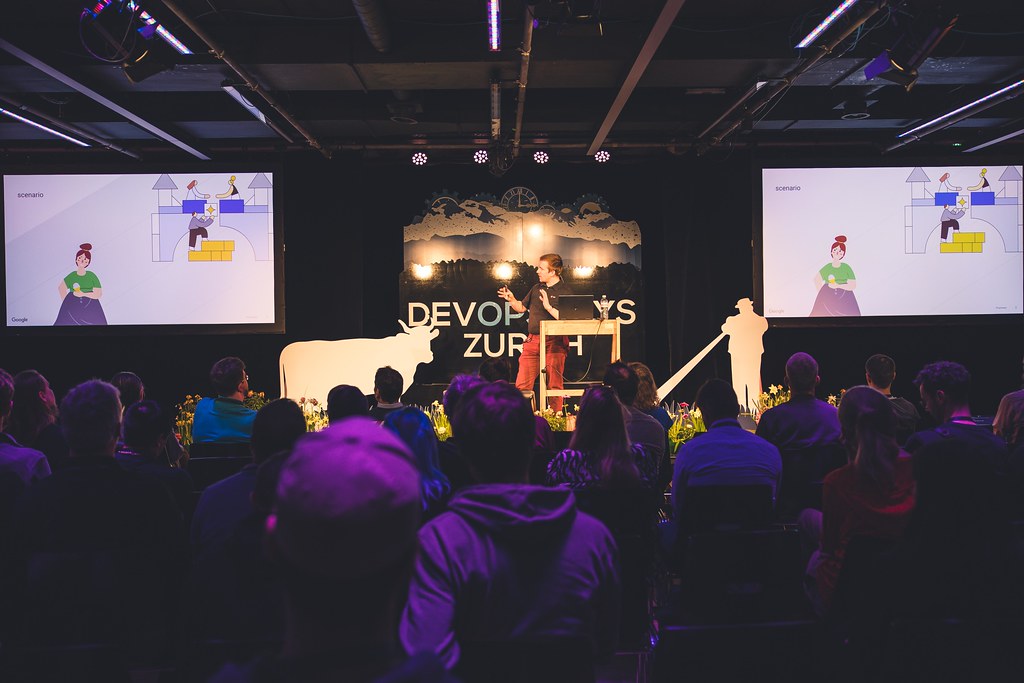
DevOpsDays Zurich is a comfy little conference on the hip(per) end of DevOps, with a crowd from Switzerland and beyond spanning diverse industries (consulting, SMB, Big Tech) and backgrounds (DevOps, other Fin/Biz/Sec*Ops, and more classical Ops or pure Dev teams.)
With its comparatively small size, the conference is a perfect opportunity to mingle and really feels like a community: You almost cannot help but run into people in different contexts, continuing and/or reframing discussions every time.
It’s part of the larger Devopsdays series, ran fully by (amazing!) volunteers. They had a few interesting logistical tricks up their sleeves.
My talk
I was honored to be able to present the inaugural version of our Planet-Scale Dashboards talk:
Mirror: Vimeo
Since the conference is single-track, this got the 250 participants’ (more or
less) undivided attention. And I had a blast presenting!
Quite a few folks approached me afterwards curious where they could get this
miracle cure — despite some (well-founded!) skepticism whether this applies to
companies which aren’t quite at ‘planet-scale.’
I believe the premise resonated with a lot of engineers; as one of my former Directors used to say, “nobody gets up in the morning to write dashboards.” I could see lots of heads nodding when I talked about toil, maintenance, and reuse; and some proverbial lightbulbs being flipped when I contrasted our approach against Infrastructure-as-Code (IaC) and Dashboards-as-Code (DaC).
An interesting discussion thread revolved around dashboards not (purely) aimed at debugging, e.g. KPI-style overview dashboards. It’s a problem I’ve been struggling with, too, and I think there’s no one-size-fits-all. In the same vein, an audience member asked how to ensure (guarantee?) dashboard quality, which is something I like to think as tangential to the reuse problem.
Open space
Now, let’s start with the open space sessions because they illustrate the breadth of material super well: proposed topics ranged from the deep technical (e.g. Platformspec), over the hype du jour (e.g. AIOps), to the softer aspects of our work (e.g. role diversity).

Open space session in the Foyer
From a bird’s eye view, I’ve gotta say is that I. Am. Frightened. when I see the challenges DevOps is (still!) struggling with: safe deployments, version control, CI/CD pipelines. The number of times I’ve heard people rant about Jenkins (hi 2010s!) or Github Actions was purely mind-boggling. In the GitOps session, I knew maybe half of the words. :-)
On version control in particular, I got pulled into a session about monorepositories (go figure) where I’ll never get tired to reference the (amazing!) Piper paper.
It was interesting (and a good signal for the Ignite selection) to see that many of the topics that didn’t get a full half hour coverage during the presentations continued in the open spaces:
- The session on diversity started strong with exploring the effects of DEI pushback, but then veered into the (in my opinion, slightly less pressing at that time) family benefits question.
- Interesting input from part-time students in the session about how to encourage more junior roles in DevOps. The audience pointed out the daunting aspects of highly-specialized roles like DevOps or SRE — and even the perception of specialization just by having its own name.
Last but not least, the session-turned-panel I attended around being a speaker made me realize — despite having been a speaker many times — how much of the advice (“focus on the narrative,” “failure isn’t necessarily about you”) applies to career panels as much as speaker selection.
AI
Since it’s 2025 and nobody can even cross the street without mentioning artificial intelligence, here goes.
Marc presented an interesting case study in From Athlete to Algorithm: Transforming Canoe Technique Analysis with AI, which was the opening keynote. It is, however, quite telling that the best AI success story we can collectively identify isn’t actually AI but machine learning.
Marc and I discussed whether it could’ve been AI later, but their data sets are simply too small (and simulations too complicated) to warrant any sort of actual ‘AI.’
A point that’s worth repeating is that — while the AI/ML model they came up isn’t 100% perfect — it’s still cheaper, better, faster than a human. And that should be the bar.
Talks
Now for the rest of the talks, let’s begin at the closing keynote:
Bertrand Delacretaz talked about
The Power of Simplicity: Crafting Durable Software Systems.
Bertrand is quite a character, and I think I don’t have to say much more than he
played kazoo on stage.
His talk was an excellent reminder that software needs to be as simple as the
requirements possibly allow. But don’t confuse that with ‘simplistic,’ which
would be too simple.
I would personally recommend Christina’s talk Building Internal Platforms to Enhance Developer Experience because it resonated so much with my lived experience.
Lena did an excellent walkthrough in Level Up Your Serverless Game (and her slides are the first Gemini-powered ones that don’t look like a cyberpunk/corporate dystopia.) However, the consensus in the room seemed to be that serverless was dead, or at least not worth the effort.
I also loved Daniel’s talk about Pipeline Patterns and Antipatterns (check out the slides he tours around with). While the talk focused on CI/CD pipelines, some of the concepts can be extrapolated to general pipelines (but, to be fair, may be more obvious in those contexts.)
Ignite
If you only have five minutes to spend on all of the presentations, I’ll have to say go and watch Sandra’s Breaking Ba(l)d: How to Prevent Burnout and Thrive. BALD is short for ’take Breaks,’ ‘Assert boundaries,’ ‘Lean on others,’ and ‘Do what you love.’
Verena brought a couple of actionable suggestions in How can we make tech conferences more diverse?. The one that stuck with me: Bring a friend!
Kamali’s No estimates? Try Flow Metrics was another good reminder on the popular “don’t estimate, compare.”
And then sometimes, genius is hard to tell apart from obsession: Jonas reverse engineered much of the Software at Tesla by looking at public artifacts like Youtube channels. For example, based on the number of updates his Tesla was getting he made some interesting points about their release qualification process.
Logistics
As a Zurich (city) resident, I’ll have to say Devopsdays plays fast and loose
with the Zurich moniker, taking place 30 minutes away from Zurich main
station in only the second
2nd largest city in the Canton of
Zurich.

DevOpsDays 2025 at Alte Kaserne Winterthur
There are a number of tricks other conferences should copy:
- The Pac-Man Rule to facilitate group mingling, which seemed especially useful with… engineers. :)
- Ignite talks, which are an interesting take on Lightning Talks, with 20 slides on auto-forward after 15s.
- Fairly common but well-executed was the raffle, where participants had to collect stamps from all booths (i.e., get exposed to all sponsors) and also collect their prize in person (i.e., stay until the conference end.)
All photos are © DevOpsDays Zurich 2025 unless otherwise noted.