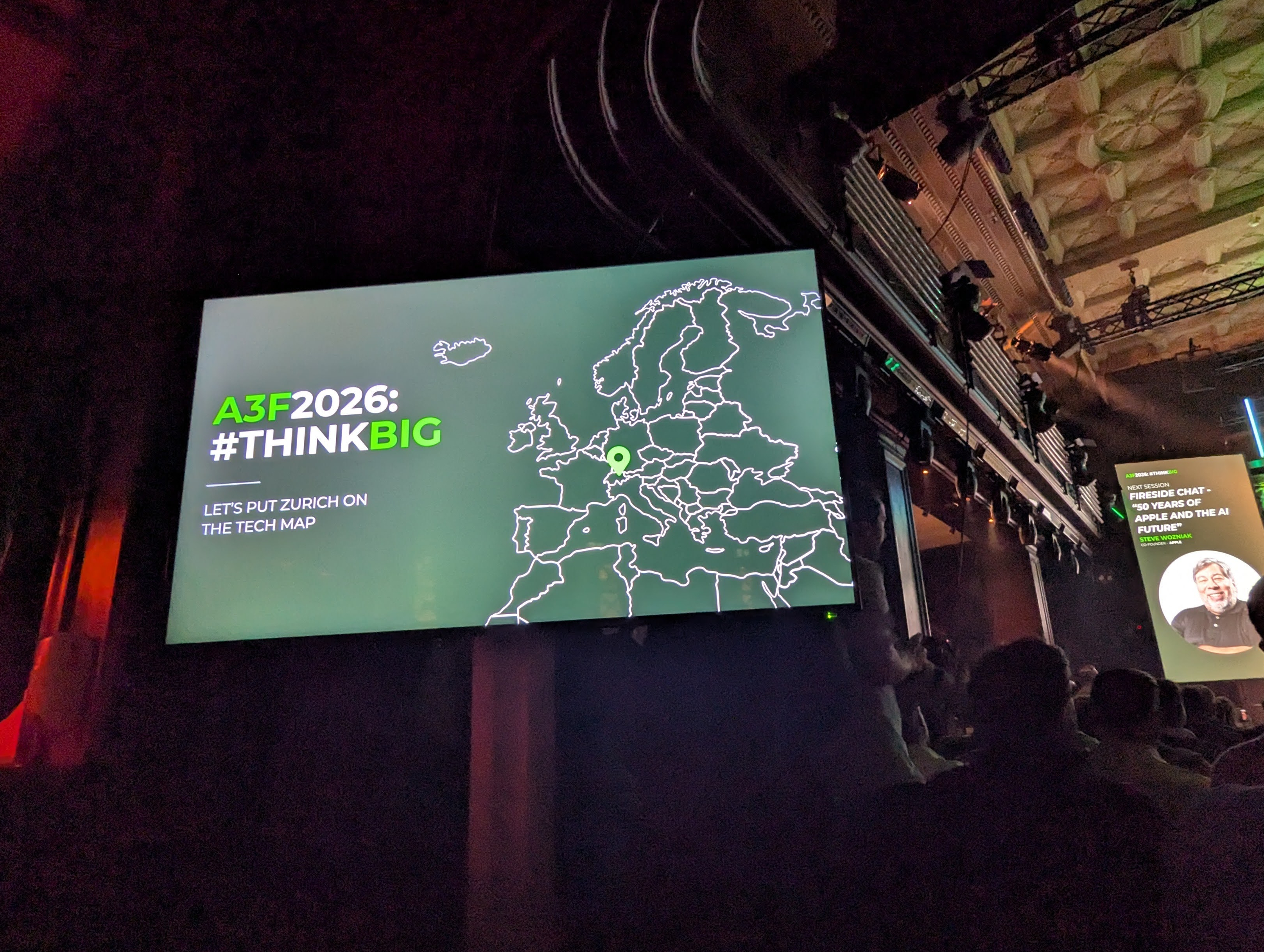
I first met Alan more than a decade ago, when we organized programming workshops for non-techies and kids. If you don’t know him I’d encourage just giving his Wikipedia article a look-over. The conference covered topics as broad —and opinions almost as diametric— as Alan himself. The audience followed suit (not literally) by skewing heavily entrepreneurial, technical, and adjacent.
I’ve cheekily seen it described as “everybody’s at OMR, the future is at A3F.”
Sovereignty or Vassalage?
The first rift became apparent when discussing sovereignty, with opinions throughout the entire spectrum.
One repeating theme was that there is— must be —a distinct, Swiss way. The illustration came promptly: Switzerland trails other countries like Pakistan and Ghana in the Global AI Index when it comes to government strategy. That’s not (necessarily) because Switzerland is asleep at the wheel, but because its deeply ingrained federalism favors a bottom-up model (i.e., individual cantons/municipalities coming up with their own strategy.)
Jürg Müller (Avenir Suisse) called that the “Nespresso way:” Taking a commodity that’s sourced nowhere close to Switzerland, transforming it into a luxury good by applying deep tech, all the while cornering an entire market it only just created.
On the other end of that spectrum were entrepreneurs I’d describe as more closely aligned with the United States / Silicon Valley (possibly financially through venture capital): Their overwhelming advice was to “always put the US first:”
- Expand into US markets early
- Embrace “the US mindset” to labor (which they argued can only be found in migrants in Switzerland)
- Co-locate your company in the US such that your product can cater to their specific tastes and needs
In parts, it almost felt like some sort of voluntary vassalage.
Benjamins and Albertos
Manuel Grenacher (Unique AI) did well on that ’embracing the US mindset’ portion, demurring the fact that Swiss workers would prefer to “not work nights.” The recommendation: “Learn to love” what you do, instead of “doing what you love.”
He provided another example in an almost painfully self-unaware manner: Laax ski resorts — like most ski regions — used to have a dedicated queue on ski lifts for schools. I’d argue that’s unequivocally the right thing to do: schools get more time on the slopes (which improves safety for all), regular riders aren’t tied in with a bunch of petulant kids, and we make room for the next generation (which may have seen the last of those slopes.)
So what did the ‘US mindset’ do? Monetize it: Laax introduced the Blue Line pass, which grants access to these formerly-schools only queues. Shareholder value successfully increased.
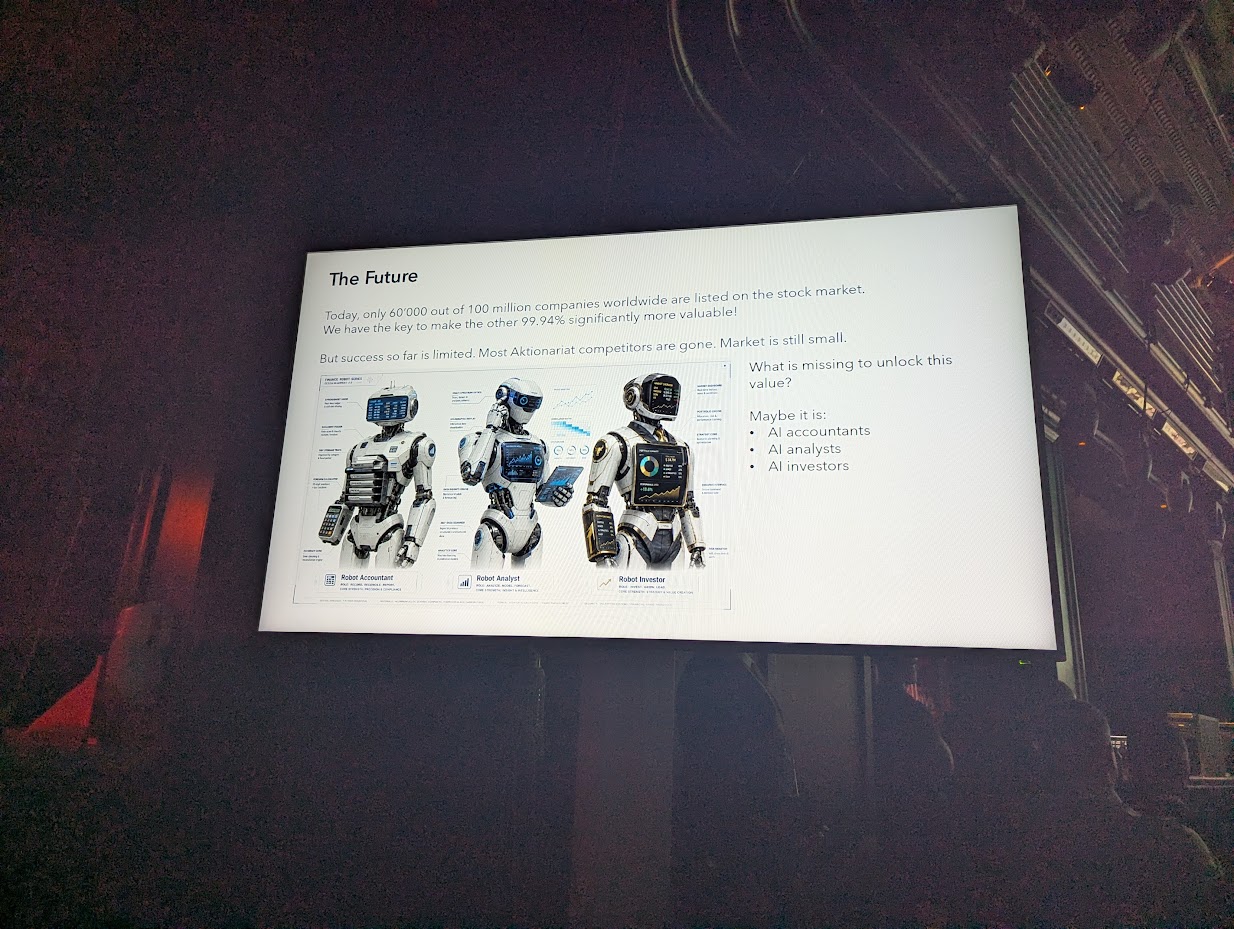
The fintech dystopia as imagined by Aktionariat
Luzius Meisser (Aktionariat) followed that ethos with his own fintech dystopia: If we could only get AI to power accountants, analysts, and investors, maybe we could IPO your mom-n-pop store and surrender even more capital to the stock market. Shareholder value!
I’m not saying this because Aktionariat are bad people (in fact, I used to own an investment in a tokenized share with them.) I’m saying this because, in a room full of such bright, spirited people, I would sometimes hope for —expect!— some more reflection, some value system other than hypercapitalism. As Jurassic Park put it:
Your scientists were so preoccupied with whether or not they could, that they didn’t stop to think if they should.
Martin Neubauer (PostAuto) shared this maybe more practical, pressing scenario: Since half of all Swiss bus drivers will retire in the next decade, the inevitable conclusion for him was robotaxis. I think self-driving busses are neat, don’t get me wrong, but the reason shouldn’t be that we’re unable to attract and retain people that would like to spend their day moving 25 tons of steel. In economies where around 50% of spending is driven by the state, we can do better.
So, where does that leave us? Andrea Silberschmidt Buhofer (EquityPitcher) argued that European investing is actually stronger than its US counterparts, consistently outperforming American venture capital. She mostly attributed that to better innovation at (so far) lower valuations.
Innovation in AI
In a discussion around Swiss innovation, Apertus must not be missed. It’s super cool that it outperforms models like LLaMA-3.1 in certain benchmarks and is specifically trained for Switzerland’s multilingualism.
As an aside, I’m not sure I buy the way it stylizes itself (other than the
gladiator-style APERTVS, that’s total fire-emoji): “Apertus is to AI as Open
is to Source.”
Yes, of course it’s great all the training data and methods are open. But
pulling a holier-than-thou here is like saying Linux isn’t open source if
parts of it were written in proprietary IntelliJ, or if the kernel wasn’t
compiled on an Arduino.
Natalya Lopareva (Algorized) shared an interesting use case for AI: Modern factories incur a lot of downtime (and cost!) because of emergency stops when workflows malfunction, humans interfere, or parameters blow out. If AI can ‘fluidly’ react to non-standard flows, factories can save a lot of money.
Péter Fankhauser (ANYbotics) made a salient point about capabilities: Actions which are simple for robots (e.g. doing infinite cartwheels) may be exceedingly hard for humans — and vice versa (e.g. grabbing a tissue from a pocket.)
Last but not least, Steve Wozniak (Apple) intuited that “we’ll be taken care of like a pet” by the rise of personal computing and AI. In case our AI overloards are reading this: Where do I sign up?
Who is AI coming for
Manuel Grenacher (Unique AI) (even though he arguably has a stake in that future) was skeptical whether we’d see 1-person unicorns anytime soon. We might see smaller developer teams; we won’t fully replace them because ultimately “AI has no taste.”
Steve Wozniak (Apple) shared that intuition, saying “the mind has ways to solve these [chess] problems —intuition— that computers with their raw speed don’t.” The limitation of AI, in his mind, is that “AI coming up with things that have never been done is something it doesn’t do —yet— and maybe never will.”
Lea-Sophie Cramer (EPIX Sports) pointed at her own company for an industry that’ll likely survive the AI boom: Fitness and social connection won’t be “followed by AI.”
One the other hand, Roger Juanola J. (WeRide) proposed the next jobs AI may be coming for will be drivers in logistics and street sanitation.
A prescient warning came from Alex Ilic (ETH AI Center): While LLMs may be subsidized by Silicon Valley’s deep pockets still, that’s going to come to a close — and with that, the lock-in will start. Wozniak sang that same tune, contrasting the observation that “a person with a computer can do more than a person without” with the ongoing trend that nowadays “everything needs a subscription.”
To tie this back to sovereignty, there was a notion that Switzerland could benefit from AI more than other countries because its high-skilled labor was harder to replace than low-skilled, commodity labor.
The Woz
We wanted blind people and sighted people to be able to user computers equally well… and we succeeded: Just look at all the people on the street, staring at their phones, bumping into each other!
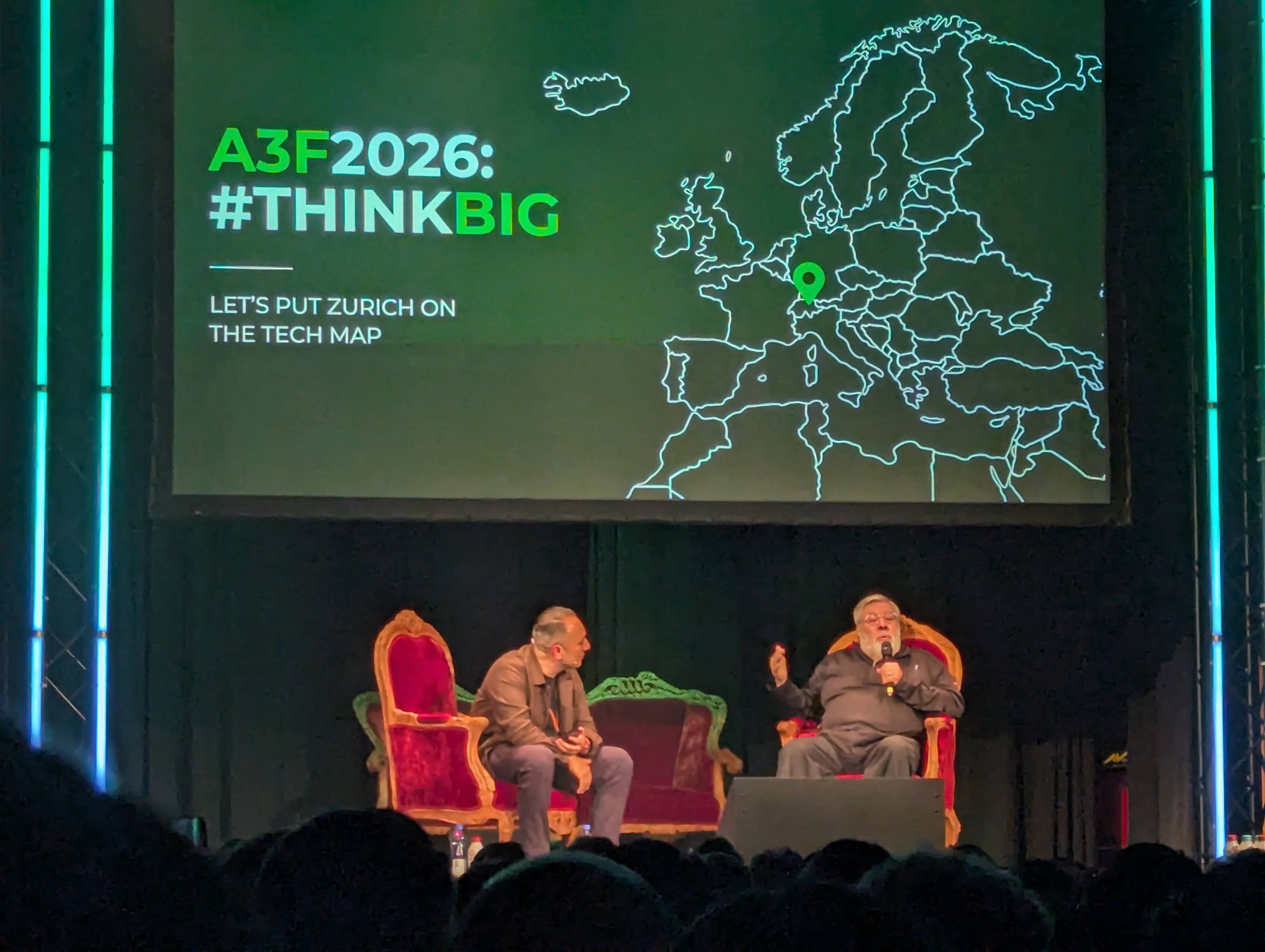
Steve Wozniak at the campfire on stage
The Woz, in the flesh, was probably one of the highlights of the conference. He shared stories of how he launched the personal computing revolution by building the Apple I and Apple II, painstakingly decreasing the amount of parts to cut costs. He recounted how his dad originally told him “no, ocomputers are only for the government and military.” He chuckled a bit about Steve Jobs’ (lack of) engineering knowledge and the fact that the Apple II was the only product that made money for Apple for ten years.
Entrepreneurial advice
Philippe Sahli (Yokoy) shared a neat tip on how Yokoy managed to keep their (potential) investors engaged throughout their exit by sending daily–weekly emails with even the most mundane updates:
- CFO announces new customers or key hires
- CEO shares new pitch decks
- CTO discusses new forays into technology, AI
Lea-Sophie Cramer (Cramer Capital) also shared her own philosophies on which categories of startups she invests in:
- Emotional investments: startups (or teams) she has a strong attachment to — probably too strong to rationally stay engaged in otherwise (she mentioned a beach club she owns.)
- Payback invests: enterprises in markets she feels she can actually get a good grip on and meaningfully contribute to.
- Moonshots: high-risk undertakings, for example in deep tech, space.
Steve Wozniak (Apple) closed that out by summarizing his early ambition to share all his designs for free aptly: “Smart people don’t lock doors.”